Khatchig Mouradian is a lecturer in Middle Eastern, South Asian, and African Studies (MESAAS) at Columbia University, an adjunct lecturer at the Johns Hopkins School of Advanced International Studies (SAIS), and the Armenian and Georgian Specialist at the Library of Congress.
Mouradian serves as Co-Principal Investigator on two interdisciplinary research initiatives: the Connectivity and Individuality in Textual Traditions project, funded by a Schmidt Sciences Humanities and AI Virtual Institute (HAVI) grant; and the Armenian Genocide Denial Project at New York University’s Global Institute for Advanced Study.
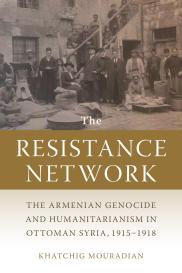
Mouradian is the author of the award-winning book The Resistance Network: The Armenian Genocide and Humanitarianism in Ottoman Syria, 1915–1918 (2021). He is co-editor of After the Ottomans: Genocide’s Long Shadow and Armenian Resilience (2023) and The I.B. Tauris Handbook of the Late Ottoman Empire: History and Legacy (2025). His scholarship explores genocide, concentration camps, humanitarianism, unarmed resistance, midwifery in the Middle East, and pedagogy, with articles and chapters published in numerous journals and edited volumes.
At Columbia, Mouradian is Associate Faculty in both the Harriman Institute and the Institute for the Study of Human Rights, where he teaches undergraduate and graduate courses including “The Ottoman Empire: History and Legacy,” “Urban Space and Conflict in the Middle East,” “War, Genocide, and Aftermath,” “Apologies and Non-Apologies,” “Literature of the Great War in the Middle East,” and “A Social History of Concentration Camps.” He previously held teaching positions at California State University – Fresno, Rutgers University, Worcester State University, Stockton University, and the University of Wisconsin – Milwaukee.
Mouradian’s work and commentary have been featured in The Washington Post, BBC, France 24, The New York Times, The Economist, The Boston Globe, Newsweek, among other international outlets, addressing issues of public apologies, human rights, mass violence, and politics in the Middle East and the South Caucasus.
In 2025, he became the first historian to be featured in the USC Shoah Foundation’s Dimensions in Testimony interactive biography series.

